crush emphasizes the compactness of the group, the difficulty of individual movement, and the attendant discomfort.
a crush of fans
mob implies a disorderly crowd with the potential for violence.
an angry mob
Examples of crowd in a Sentence
Verb
Boxes crowded the floor of my apartment.
There are too many products crowding the market.
The club has been accused of crowding too many people into too small a space.
By the end of the 10th mile, three bicyclists were crowding the racer in front.
Please move back. You're crowding me. Noun (1)
a huge crowd of fans was on hand to greet the returning World Series champions
the fashionable crowd at the polo tournament
no national leader was ever more hated by the crowd
Recent Examples on the Web
Examples are automatically compiled from online sources to
show current usage.Read More
Opinions expressed in the examples do not represent those of Merriam-Webster or its editors.
Send us feedback.
Verb
Chino Hills State Park is almost never crowded, except during a spring super bloom, when the hillsides erupt in California poppies and hordes of would-be influencers arrive to take photos for Instagram.—
Jack Dolan,
Los Angeles Times,
25 Aug. 2026 For someone with a flexible foot or a narrow forefoot where the toes tend to crowd each other, separating the big toe from the second toe can reduce rubbing and irritation.—
Karla Rodriguez,
Footwear News,
24 Aug. 2026
Noun
The 100-meter sprint in Beijing’s National Speed Skating Oval brought together the world’s fastest runners, hurtling along at breakneck speed to shrieks of excitement from a captivated crowd.—
Sarah Shephard,
New York Times,
1 Sep. 2026 Easley said a community gathering organized in support of the brewery on Saturday drew a large crowd, with some of the drag brunch’s vendors and a food truck showing up to support the brewery.—
Evan Moore
august 31,
Charlotte Observer,
31 Aug. 2026 See All Example Sentences for crowd
Word History
Etymology
Verb
Middle English crouden "to push forward, jostle, press, push or drive (something wheeled)," going back to Old English crūdan "to crowd, press (against), press forward (of a ship)," going back to Germanic *krūdan- "to press, push forward" (whence also Middle Dutch crûden "to push, shove, trundle," Norwegian regional kryda (preterit kraud) "to flow together, congregate"), of uncertain origin
Note:
Old English crūdan, a Class II strong verb, is attested twice in poetic texts, as crydeþ (third person singular present) and cread (third singular preterit); evidence in other old Germanic languages is lacking. Nominal derivatives *kruda- and *krudan- are evident in Old English lindgecrod "shield-bearing crowd" and lindcroda "shield-press, battle"; the same underlying forms may be evident in Middle Dutch crod "hindrance, bother," Middle High German krot "annoyance, distress," kroten, kröten "to bother, annoy." (Further Frisian and Low German forms are detailed in the Oxford English Dictionary, first edition, s.v. crowd.) See also crud entry 2.
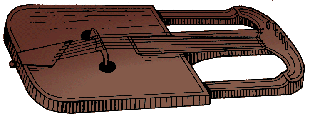
Middle English crouþ, croude, borrowed from Middle Welsh crwth "crowd (the instrument), fiddle, hump, humpback, anything round or bulging," going back to Celtic *krutto- "round or bulging object" (whence also, from a feminine derivative *kruttā, Welsh croth "womb, belly"; also Middle Irish crott, cruitt "harp, lyre, hump," Middle Breton courz "female genitals"), probably of expressive origin
Note:
The word crotta as the name of a musical instrument was used by the sixth century Latin poet and hymnodist Venantius Fortunatus ("… crotta Britanna canat" - "… may the British crotta sing"). The grounds for the shift from th to d in the English word are uncertain.


 Copy Citation