The Words of the Week - Aug. 28
Dictionary lookups from music, social media, and the Supreme Court
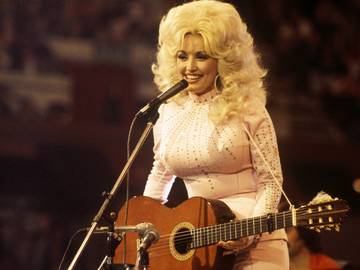
The death of music legend Dolly Parton caused lookups for the word dolly to spike on Wednesday.
Dolly Parton, Superstar Whose Songs Spoke to Millions, Dies at 80
—(headline), The New York Times, 25 Aug. 2026
We define several senses of the word dolly, the most common of which is synonymous with doll, referring to a small-scale figure of a human being used especially as a child’s plaything. Although the name dolly and doll originated as nicknames for “Dorothy,” Dolly Parton was born Dolly Rebecca Parton.
Articles published this week in the New York Post and other newspapers quoting a week-old tweet by a member of the Democratic Socialists of America led to a rise in lookups for noblesse oblige.
Everyone’s trying to dunk on me for being a progressive from a privileged background but like have yall never heard of noblesse oblige? I have a moral obligation to use my advantages to help those who are struggling
—
We define the noun noblesse oblige as “the obligation of honorable, generous, and responsible behavior associated with high rank or birth.” In French, noblesse oblige means literally “nobility obligates.” It was first quoted in English in the early 19th century, before being used as a noun referring to the unwritten obligation of aristocrats to act honorably and generously to others. Later, by extension, it also came to refer to the obligation of anyone who is in a better position than others—due, for example, to high office or celebrity—to act respectably and responsibly.
The adjective Kafkaesque was trending last week for being a Word of the Day quiz answer on our website, and this week for being used by Supreme Court Justice Ketanji Brown Jackson in a dissent.
The three liberal-leaning justices publicly dissented, with Justice Ketanji Brown Jackson writing that the rule “lets another shoe drop in the Kafkaesque nightmare that our precedents have been steadily creating for certain plaintiffs who seek to bring election-related challenges.”
—
Franz Kafka (1883-1924) was a Czech-born German-language writer whose surreal fiction vividly expressed the anxiety, alienation, and powerlessness of the individual in the 20th century. The opening sentence of his 1915 story The Metamorphosis has become one of the most famous in Western literature (“As Gregor Samsa awoke one morning from uneasy dreams he found himself transformed in his bed into a gigantic insect”), while in his novel The Trial, published a year after his death, a young man finds himself caught up in the mindless bureaucracy of the law after being charged with a crime that is never named. So deft was Kafka’s prose at detailing nightmarish settings in which characters are crushed by nonsensical, blind authority, that writers began using his name as an adjective a mere 16 years after his death.
Both minstrel and blackface were looked up more than usual this week following a news story about a children’s Halloween costume.
Target apologized on Monday and said it had stopped selling a children’s Halloween costume after facing widespread criticism that the design evoked racist stereotypes of Black people. … Minstrel shows were a form of 19th-century American theater built around caricatures of Black people and culture. Performers, who were usually white, wore blackface and enacted these caricatures for predominantly white audiences.
—
We define the relevant sense of minstrel as “a member of a type of performance troupe caricaturing Black performers that originated in the U.S. in the early 19th century.” Such minstrels typically performed in blackface, defined as “dark makeup worm to mimic the appearance of a Black person and especially to mock or ridicule Black people,” and featured exaggerated and inaccurate representations of Black people in songs, dances, and comic dialogue. The popularity of minstrel shows in their heyday played a significant role in promoting negative racial stereotypes, and the use of blackface is considered deeply offensive.
The verb digress has been trending likely in connection to a question that was recently posted in the “No Stupid Questions” forum of the website Reddit.
Why do people say “but I digest” after saying a sentence?
—
To date, this question has received nearly 1,000 responses, many of them pointing out that the common phrase is actually “But I digress …” To digress is to speak or write about something that is different from the main subject of attention or course of argument, while to digest something, specifically food in the most common use of digest, is to convert it into absorbable form. “But I digest” is an example of a malapropism, the use of a word sounding somewhat like the one intended but ludicrously wrong in the context.
We define the noun ubiety as “the quality or state of being in a place.” As such it can refer to the state of being placed in a definite local relation, or to the abstract quality of being in position. The word combines the Latin ubi, meaning “where” with the English -ety, as in society. Ubiety is labeled “archaic” in our Unabridged dictionary; this indicates that modern evidence of the word’s use exists, but that it is currently only used sporadically, and then chiefly in special contexts such as poetry and historical fiction. But don’t let this stop you from busting it out when appropriate, no matter your spatial or temporal ubiety.
[Stanley] Kunitz maintains an estival [i.e., summer] home on Cape Cod and has long been associated with its literary and artistic life. His poetry is often imbued with the ubiety of the seaside landscape.
—